Wednesday, February 9, 2022

The Hydrology Class 2022 - Introduction


What the Hydrology Course is About


To have an idea about this class, please look at the Syllabus  slides in first lecture.  This year the class will be 90% similar to the one of the last year.  Laboratory work will be (mostly) concentrated in May and June. March and April up to Easter will be mostly spent to develop the theoretical parts.
Lectures  and lab classes will be recorded and uploaded on my VIMEO channel. Old videos are also in my on my YouTube channel.

The intermediate exam will be written (or oral *) with 3 questions about the topics treated.  The students will be asked to answer with text, figures and formulas. The final exam will be a discussion of the exercises provided by the students int the form of Jupyter notebooks. Each of the exercises will be discussed separately by booking an appointment with the professor before the formal date of the exam or at the day of the final exam. 

This Hydrology class aims to explain the physics (meaning the mathematical equations and their phenomenology) and, in some cases, the statistics (i.e. the distribution) of the basic hydrological processes (precipitation, runoff, infiltration, evaporation and transpiration)
Students will be required to:
  •  being able to derive and comment the hydrological equations above mentioned and 
  • to do some statistics on hydrological data. Particular attention will be dedicated to the derivation of the statistics of extreme rainfall.
  • Besides students will be requested to get some basics of the tools that will be used to estimate the hydrological fluxes (using a GIS, Python, and other tools, among those in GEOframe).
They will be required to be able, by means of some models provided by the instructors the main hydrological fluxes and represent them at catchment scale.

This is intended to serve as a basis for getting further knowledge and
  • prevent, manage, control floods, landslides and snow-avalanches
  • manage irrigation
  • estimate water availability for hydropower production
  • forecast roads freezing
  • estimate soil, roads, or snow temperature
  • forecast snow water equivalent and snow height
Assuming that the student will take a master in Environmental Engineering at Trento University, Acquedotti e fognature, Modelli idrologici, Ingegneria fluviale, are classe that request the knowledge communicate in this Hydrology class. 

The first part of the course, until April 3, will be dedicated to the presentation and discussion of theoretical concepts through lectures that will be videotaped and uploaded on the course's Vimeo channel. The lessons will cover 4 of the five hours per week. The fifth hour will be devoted to simple exercises with Python and Jupyter lab and to the preparation of the data necessary for the projects to be completed in the second part of the course in groups of two or three students.
The student must take care to understand the hydrological concepts and discuss them with the lecturer. The first twenty minutes of each lesson will be devoted to the discussion of the topics covered in the previous lesson. Each group will have to prepare one question or comment to which the teacher will answer. A summary of the lesson will follow, followed by the actual lesson. The second part of the course will take up the theoretical themes of the first part and using the tools made available to the GEOframe system. Students, in groups of two or three, will have to:

  • Analyze a series of rainfall and hydro-meteorological data with the use of Python 
  • Estimate the intensity-duration-frequency curves with the methods presented in the first part of the course using the data of a hydro-meteorological gauge station
Besides, they have to accomplish two of the following three tasks under the supervision of the tutor and the teacher: 
  • Design and run some infiltration simulations in complex soils and discuss the results.
  • Design and perform the calculation of evaporation and transpiration in a chosen site
  • Studying the coupled transpiration and infiltration in one site. 
* The exam will be written if COVID-19 will allow the students to be in classroom. Otherwise it will be oral. 

References

The lessons will be video recorded and made available. Each lesson will be given through slides in English which will be delivered to students in advance. When necessary, the lessons will be accompanied by appropriate in-depth articles. There is no real text because the course, even when it is fully in the hydrological tradition, elaborates the concepts in a contemporary way and uses innovative tools.

As general reference texts we recommend:
  • Bras, R.L, An introduction to Hydrologic Science, ISBN-13: 978-0201059229, 1989 - ISBN-10: 0201059223, Addison-Wesley (July 1, 1989)
  • Brutsaert, W., Hydrology: an introduction, ISBN-13: 978-0521824798 - ISBN-10: 0521824796, Cambridge University Press, 2005
  • Dingmann, L., Physical Hydrology, ISBN-13: 978-1478611189, ISBN-10: 1478611189, Third Edition, Waveland Press, 2015
  • Freeze, A. ; Cherry, J., Groundwater, 1979
  • Lu, N. and Godt, J.W., Hillslope Hydrology and Stability, Cambridge University Press, ISBN-13: 978-1107021068, ISBN-10: 11070210652010, 2013

These books represent a shareable review of phenomena and hydrological modeling but the methods they present are not necessarily those used in the course. The course, also for reasons of time, presents a selected and limited perspective of the subject that the texts cited dissect from various points of view.

Friday, January 21, 2022

Seven Steps in Modelling a Catchment - Reprise

 Recently I delivered a post where I discussed the the steps in doing a catchment analysis, based on the previous recent experiences on the topic.  The seven steps are in brief:

  1. Clarify the scope of your analysis and gather the information
  2. Analyse the catchment geomorphology
  3. Analyze all the available data
  4.  Make the simulations plan and setting up the simulations 
  5. Running the simulations
  6.  Showing and discussing the results and their reliability
  7.  Deploy all what done for Open Science


Another step, actually is building or choosing  the model, which previously was given for granted (so actually the 7 steps can be 8 but this obviously does not really matters. During the GWS2022 I went further in developing a presentation in three parts and I deployed it, 


Sunday, January 9, 2022

WHETGEO essentials

Water, HEat and Transport in GEOframe  (WH?ETGEO) is the set of components which was conceived and developed to substitute GEOtop. It with GEO-SPACE more precisely. Its design is more complex than GEOtop, since it includes various modelling solutions, 1D, 2D, 3D (coming soon) and additional processes can be added without large efforts. 2D and 3D versions can work with an unstructured grids and there is a lot of flexibility to be exploited to pursue new ideas that were not even conceivable with GEOtop. 


At present the best presentations of the models and the ideas are obtained by reading the Niccolò Tubini Ph.D. Thesis and the paper on GMD just published. WHETGEO + GEOSPACE have a dedicated summer school whose 1st edition was celebrated recently.  The index of GEOframe Schools can be found here.

Other contributions will come soon. 

References

Tubini, N. 2021, June. “Theoretical and Numerical Tools for Studying the Critical Zone from Plots to Catchments.” Edited by R. Rigon and S. Gruber. Ph.D., Dipartimento di Ingegneria Civile, Ambientale e Meccanica, Università di Trento.

Tubini, Niccolò, and Riccardo Rigon. 2022. “Implementing the Water, HEat and Transport Model in GEOframe (WHETGEO-1D v.1.0): Algorithms, Informatics, Design Patterns, Open Science Features, and 1D Deployment.” Geoscientific Model Development 15 (1): 75–104. http://dx.doi.org/10.5194/gmd-15-75-2022

Tuesday, December 28, 2021

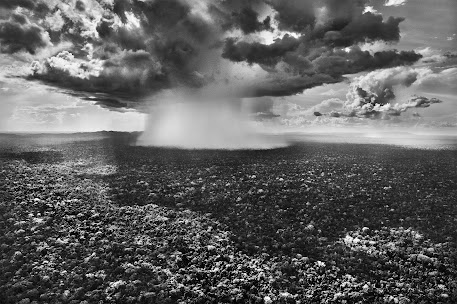
Edward Wilson (1929-2021) - A storm in the Amazon

From "The diversity of life" 

"I sorted the memories this way and that in hope of stumbling on some pattern not obedient to abstract theory of textbooks. I would have been happy with any pattern. The best of science doesn't consist of mathematical models and experiments, as textbooks make it seem. Those come later. It springs fresh from a more primitive mode of thought, wherein the hunter's mind weaves ideas from old facts and fresh metaphors and the scrambled crazy images of things recently seen. ...


The storm grew until sheet lightning spread across the western sky. The thunderhead reared up like a top-heavy monster in slow motion, tilted forward, blotting out the stars. The forest erupted in a simulation of violent life. Lightning bolts broke to the front and then closer, to the right and left, 10,000 volts dropping along an ionizing path at 800 kilometers an hour, kicking a countersurge skyward ten times faster, back and forth in a split second, the whole perceived as a single flash and crack of sound. The wind freshened, and rain came stalking through the forest. In the midst of chaos something to the side caught my attention. The lightning bolts were acting like strobe flashes to illuminate the wall of the rain forest. At intervals I glimpsed the storied structure: top canopy 30 meters off the ground, middle trees spread raggedly below that, and a lowermost scattering of shrubs and small trees. The forest was framed for a few moments in this theatrical setting. Its image turned surreal, projected into the unbounded wildness of the human imagination, thrown back in time 10,000 years. Somewhere close I knew spear-nosed bats flew through the tree crowns in search of fruit, palm vipers coiled in ambush in the roots of orchids, jaguars walked the river's edge; around them eight hundred species of trees stood, more than are native to all of North America; and a thousand species of butterflies, 6 percent of the entire world fauna, waited for the dawn.

…..

The storm arrived, racing from the forest's edge, turning from scattered splashing drops into sheets of water driven by gusts of wind. It forced me back to the shelter of the corrugated iron roof of the open-air living quarters, where I sat and waited with the mateiros. The men stripped off their clothing and walked out into the open, soaping and rinsing themselves in the torrential rain, laughing and singing. In bizarre counterpoint, leptodactylid frogs struck up a loud and monotonous honking on the forest floor close by. They were all around us. I wondered where they had been during the day. I had never encountered a single one while sifting through the vegetation and rotting debris on sunny days, in habitats they are supposed to prefer. "

Edward O. Wilson, The Diversity of life, Penguin

Monday, December 27, 2021

DARTH4MED - A Digital eARth Twin of Hydrology for the prediction of water scarcity in the Mediterranean area


The DARTH4MED, D4M for short, project aims to be a high resolution twin of the hydrology and carbon cycle of the Italian peninsula. It is based on Po, WATZON and WATERSTEM projects, making treasure of previous modelling efforts like GEOtop and the GEOframe system, and GIS tools implementations like Jgrass and the Horton Machine toolbox. It builds upon state-of-art hydrological modelling case studies of various catchment sizes, from hillslope to Po and Blue Nile. It also draws on experiences in IT applied to hydrology with developments of the object modelling system, OMS.

D4M gives substance, both technical and scientific, to the Digital Earth metaphor and exploits it to improve the work of scientists and professionals, and to support open science. It aims to provide a shared infrastructure usable by scientists and users to investigate the processes involved in the water, energy and carbon budgets, WB, EB and CB, at a very fine spatial and temporal scale, 1 km2, hourly.

The GEOframe system already contains a sophisticated and complete set of modelling components, constituting a solid basis of comparison for innovative developments. Open API and training will be offered to anyone to advance the mathematical, statistical and numerical descriptions of hydrological and eco-hydrological processes with little programming effort. From this perspective, the project will be an experiment in participatory science, since the tools developed could be improved and given back by collaborative researchers. The method of multiple hypothesis testing will be the rule of scientific endeavour.

The core of the system will manage the interactions of groundwater, vadose zone, surface water, snow, vegetation, atmosphere, usually analyzed separately, and join them seamlessly in the continuum containing the feedbacks among the parts. On these bases researchers will be able to evaluate climate, hydrologic, pedological, ecological droughts.


D4M has several primary objectives, listed below:
  • To provide the core of a DE, defined as a Digital eARth Twin Hydrology system (a DARTH), to do hydrology by computer, with an infrastructure that allows partecipative hydrology and makes Earth system science practice easier for all the Italian Peninsula.
  • To improve the modelling of the water budget, WB, energy budget, EB, Vegetation and Carbon Cycle.
  • To provide forecasts for several variables, as detailed in the Synopsis.
  • To resolve some research questions, as presented in the Synopsis.
  • To give researchers sound tools on which to base their analysis of climate, hydrologic, pedological, ecological and agronomic droughts.
  • To provide a high level of abstraction and encapsulation for modelling services, so to allow improvements to parts of the DARTHs by anyone without disrupting the whole.
  • To give API and web services to final users, researchers, technical professionals, programmers, to connect their studies and products to the whole D4M, thus combatting the fragmentation of hydrological modelling through a participatory open platform.
Besides efficient algorithms, the effort will require the smart implementation of parallel computing infrastructures, which will remain mostly invisible to the users. All the infrastructure will be open source, built with open source tools and provided with open data.

The project was just submitted for the FIS call. Here below you find the proposal and the relevant annexes.
Compressing all the ideas in such a few words was quite difficult and the platform on which we had to upload the material with some issues (non accepting, for instance "()[]-/" and other characters. Some requirements quite stupid. The selection will be great. I obviously think that the gain for the country with such a project really great. Finger crossed and, if there are better projects, hope they'll win. 

Wednesday, December 15, 2021

DARTHs (Digital eARth Twin Hydrology systems)

There is a great hype about Digital Earth Twins (DETs) and EU, ESA, NASA and other institutions issue calls for building such IT infrastructures (ITI). This paper face the topic from a point of view of hydrologists who are concerned with the science content of these ITI. The Authors see in DETs an opportunity to make easier the work of scientists and professionals. However they claim that some aspect of making science should be respected. Mainly they are the hypothesis testing and estimation of errors in hindcasting or forecasting. Beside, the Authors claim that building a DET for Hydrology (called DARTH) is an enterprise that implies some choices about the implementation of models and of the infrastructure. DARTHs are not in fact just "models" and have requirements that need to be satisfied. Finally the Authors support the opinion of an open science oriented implementation of these ITI that also allows the participatory action of all the scientists that like to contribute (and look with suspect to science processing where just a few contribute to the core science). In turn also this options has requirements that should be reflected in the implementation.
To sum up, the Authors think that this is the right moment to push these ideas and desire to open a discussion with other colleagues. 

Final published paper: 


You can find the manuscript submitted to HESS discussions HESSD at the moment in our OSF repository, here.  

UPDATE: The paper had a positive first round of reviews that you can see here.  Below, please find the revised text with the supplemental material. 

Final published paper: 

Thursday, November 11, 2021

How to write a paper on a new hydrological model component

 Let’s try to keep the matter simple.  General rules apply:


Analyzing back the general scheme, in the case of software presenting, you need a specific part dedicated to the availability and delivery of the software. The main parts required here were already illustrated in explaining the Zero Notebook contents.

Because you are talking about scientific software your methodology has two parts. One related to the science you have to produce and one related to the science of writing good software.

Taking the example of Evapotranspiration. The science could be the one included in the sub-models you are implementing. Meaning, what is the science behind Priestley-Taylor, which the one behind FAO approach, and which the one one behind, for instance, our Prospero model ? Here the material is very large so you have to work usually by extracting the essentials and citing the literature. Part of it can easily fit actually inside the introduction. The informatics has to do with the way your system is built. Which is the framework you use, in our case, OMS3, and why you use it, instead of others. It also the system you are working with, like in our case GEOframe that provides ancillary tools. Finally the informatics can boil down to the algorithms and their organization in classes. Algorithms can be new or old and irrelevant. Just in the first case it is important to mention them with details, otherwise just a a little note can be done. Classes, assuming we are talking of some OO programming, have two scopes, one is to contain the algorithms, the other is to orchestrate the software relations in order to make easy the reuse of the softwares and their expansion. This part will be routine in future, maybe, but now it is not part of the common knowledge of hydrologist, and therefore it is worth to be explained if well engineered. In explaining classes and the overall working of the software using of UML diagrams is mandatory.

In a software paper, it is debatable what is the test of the contents. Let’s say that, because we are hydrologists, we need to test both the software running, and the models’ physics.

The software running test for who is programming in Java, like we do, is obtained through the appropriate Unit Tests and this part is commented, in case, inside the section which inherit from the Notebook Zero. For the physics we have, in turn, two modes. If we are solving problems, i.e. equations,  that have an analytical solution, then we have to reproduce the analytical results. Secondly the nasty reviewer, would also see that the model reproduces measurement. Getting some measurements to reproduce is then important. A third case is also ideally possible, which is that, no measurements are available and therefore eventually the model provide a possibility to test something that was never tried before. In this case it must be emphasized that the model makes possible something that before was not not, and we have to rely to some virtual, behavioural, experiment.

If measurements are involved, new methodological steps come in: explaining the case study, first. Secondly, not differently from other cases, we have to say if parameters to calibrate and to mention the techniques we use for doing it. Explaining how we assess the goodness of the results, and finally commenting the results are the rest of the story. An exceptionally good software that does not reproduce reality is simply not useful from the hydrology point of view, even if its implementation can still provide novelties worth to be explained. The physical test, however, should not extend to be very complicate but just functional to convince that the software is doing what it is designed to do. In the mentioned case of evapotranspiration, another issue is relevant, which is the comparison among sub-models or models alternative. It is clear that different models produce different results, so assessing in which case they work or work netter is important. However, that can be pursued with moderation in a “software presentation” paper, because this is clearly an argument which requires a paper by itself. For example , in a recent paper, Clark et al., 2021, they talk of “laugh test” for emphasizing this aspect.

At the end of the post, you have some ingredients and an idea of the procedure. To cook them together for a nice result is a little of art.  In general, a good example to follow is the WHETGEO paper.