Showing posts with label Marialaura Bancheri. Show all posts

Thursday, April 4, 2019

EGU Wien 2019: A Decision Support System based on GEOframe-NewAge in a data scarce environment

NewAge in action is presented here as mainly the work of Marialaura Bancheri and her co-workers in Basilicata region. If you aske for applications, here you get them!

By clicking on  the figure, you can get the slides.

Wednesday, April 11, 2018

GEOframe-NewAGE becomes operational

Marialaura Bancheri after her Ph.D. defense mainly worked at university of Basilicata in Potenza under the supervision of Professor Salvatore Manfreda (GS) to apply GEOframe-NewAGE infrastructures to the realtime forecasting of discharges in Basilicata region. Salvatore presented the result of their work at EGU Wien 2017. Please below, find the presentation about the system implemented.
Clicking on the figure, you can access the slides. The work in Basilicata is a great achievement, even if only a few of the potentialities of the system were exploited.


Saturday, December 16, 2017

Marialaura Bancheri defense

The Ph.D. Thesis of Marialaura Bancheri is already available in a previous post. On december 14, she finally defended it. This is the video of her performance. Her topics are: research reproducibility, GEOFRAME, reservoir based modelling (or semidistributed modelling) of the hydrological cycle, travel times theory re-interpreted in the perspective of reservoirs modelling.

I have no doubt that it could be very useful to all who are interested in our recent work and to all those that try to interpret catchment scale behavior through travel times. Marialaura was an outstanding student, is an exceptional team manager, and she is looking for an appropriate post-doc position.

Thursday, August 31, 2017

A flexible approach to the estimation of water budgets and its connection to the travel time theory

This blogpost contains the Marialaura Bancheri (in this blog) dissertation for ending her doctoral studies. There is a lot of material inside that goes from how to do better hydrological models,  to doing it, to implement and deploys some OMS3 components.  Really a lot of material.
https://zenodo.org/record/858495#.WagcLNMjHwc

Clicking on the figure above, you can access the draft of the manuscript uploaded on Zenodo.  Here below, please find the Abstract of the manuscript:

Abstract

The increasing impacts of climate changes on water related sectors are leading the scientists' attentions to the development of comprehensive models, allowing better descriptions of the water and solute transport processes. "Getting the right answers for the right reasons", in terms of hydrological response, is one of the main goals of most of the recent literature. Semi-distributed hydrological models, based on the partition of basins in hydrological response units (HRUs) to be connected, eventually, to describe a whole catchment, proved to be robust in the reproduction of observed catchment dynamics. 'Embedded reservoirs' are often used for each HRU, to allow a consistent representation of the processes. In this work, a new semi-disitrbuted model for runoff and evapotranspiration is presented: five different reservoirs are inter-connected in order to capture the dynamics of snow, canopy, surface flow, root-zone and groundwater compartments.
The knowledge of the mass of water and solute stored and released through different outputs (e.g. discharge, evapotranspiration) allows the analysis of the hydrological travel times and solute transport in catchments. The latter have been studied extensively, with some recent benchmark contributions in the last decade. However, the literature remains obscured by different terminologies and notations, as well as model assumptions are not fully explained. The thesis presents a detailed description of a new theoretical approach that reworks the theory from the point of view of the hydrological storages and fluxes involved. Major aspects of the new theory are the 'age-ranked' definition of the hydrological variables, the explicit treatment of evaporative fluxes and of their influence on the transport, the analysis of the outflows partitioning coefficients and the explicit formulation of the 'age-ranked' equations for solutes. Moreover, the work presents concepts in a new systematic and clarified way, helping the application of the theory.
To give substance to the theory, a small catchment in the prealpine area was chosen as an example and the results illustrated.
The rainfall-runoff model and the travel time theory were implemented and integrated in the semi-distributed hydrological system JGrass-NewAge. Thanks to the environmental modelling framework OMS3, each part of the hydrological cycle is implemented as a component that can be selected, adopted, and connected at run-time to obtain a user-customized hydrological model. The system is flexible, expandable and applicable in a variety of modelling solutions.
In this work, the model code underwent to an extensive revision: new components were added (coupled storages water budget, travel times components); old components were enhanced (Kriging, shortwave, longwave, evapotranspiration, rain-snow separation, SWE and melting components); documentation was standardized and deployed.
Since the Thesis regards in wide sense the building of a collaborative system, a discussion of some general purpose tools that were implemented or improved for supporting the present research is also presented. They include the description and the verification of a software component dealing with the long-wave radiation budget and another component dealing with an implementation of some Kriging procedure.

Thursday, December 15, 2016

A travel time model for estimating the water budget of complex catchments

This is the presentation given by Marialaura Bancheri for her admission to the final exam to achieve a Ph.D. in Environmental Engineering. It contains a synthesis of her studies about spatially integrated models of the water budget, and about travel time theory. A model structure is also presented preliminarily containing five reservoirs.
These reservoirs model the hydrology  of a  Hydrologic Response Unit (HRU) of a basin  which are connected together to treat a river catchment (as shown in Rigon et al. 2016). The figure above is a Petri net representation of the set od ordinary differential equations that  constitute the mathematical models of a HRU. The model uses the river network structure to organise the components execution, a work made conjointly with Francesco Serafin.
By clicking on the Figure, you will see Marialaura's presentation.

Sunday, July 10, 2016

JGrass-NewAGE at IEMSs in Toulouse 2016

JGrass-NewAGE is growing and the readers of this blog know it. We are presenting the state-of-art-of the infrastructure in Tolouse IEMSs biennial meeting, and the presentation that will be given by Marialaura Bancheri is below (click on the Figure).
Improvements are not only on the number of components, but also in their internals. Many components now runs faster and are less error-prone. At the end of the presentation you can find the links to relevant papers. Enjoy!

Monday, December 14, 2015

Age-ranked storage equations for river Adige

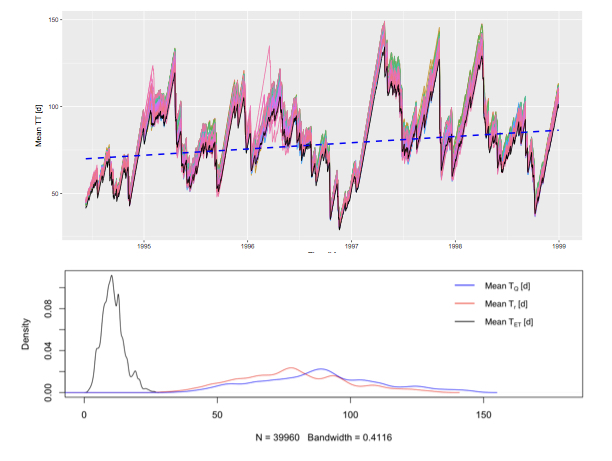
This below is the presentation that Maria Laura Bancheri is giving today at the AGU fall meeting. It summarises our recent work on travel time distributions theory (no contributions so far -well look at here -, but we tried to clarify concepts and mathematics) and its ongoing application to River Adige.

All this knowledge is going to flow into the great family of JGrass-NewAGE components and being used to assess age of water and tracer movements. 
Keep looking for upgrades.