Wednesday, October 3, 2018

Kirchner 2016 model

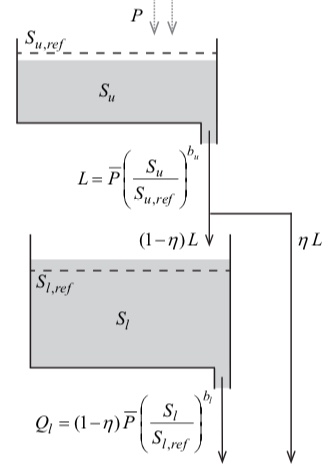
I open a new series of posts that analyze simple (or less simple) lumped (reservoir based) Hydrological Models. They are Dynamical Systems and they are well represented through Petri Nets introduced in Reservoirology #3. The present is the case of a simple two reservoirs model presented in Kirchner 2016 (from now on, K2016b).


Because of  its simplicity, K2016b is a nice case study to test and verify various aspect treated more abstractly in Rigon et al., 2016.  The presentation that contains K2016 is here.

Reference

Kirchner, J. W. (2016). Aggregation in environmental systems-Part 2. Catchment mean transit times and young water fractions under hydrologic non-stationarity. Hess, 20, 299–328. http://doi.org/10.5194/hess-20-299-2016

Tuesday, October 2, 2018

Richard Rotunno on the predictability of Storms

In these days we have here in Trento,  at my Department, Richard Rotunno (GS), a pleasant person and an outstanding scientist. His field of interest is meteorology and micrometeorology and, in particular, the evolution of storms.  Here in Trento he gave various seminars and in particular one  on the predictability of storms, which he permitted to share with you.
As usual, by clicking on the above image, you will be able to access the presentation. He cited some interesting papers that you will find below. On the butterfly effect, you can also see this my previous post, to which I think the literature cited by Richards add something important.

References (In the order in which they are cited)

Monday, October 1, 2018

Floods in Alberto Viglione research

I had the honour to be in the committee that selected Alberto Viglione (GS) to become Associate Professor at Politecnico di Torino.  Alberto gave a nice seminar entitled "understanding and Estimating River Flood Hazards across Timescales" which covers some issues on flooding forecasting and variability in space-time.
I really appreciate his point of view which is different from mine and from which I can learn a lot, therefore I  asked him the permission to publish his presentation in my blog here. Please by clicking on the Figure above, find Alberto's presentation.

References

Archfield, S. A., R. M. Hirsch, A. Viglione, and G. Blöschl (2016), Fragmented patterns of flood change across the United States, Geophysical Research Letters, doi:10.1002/2016GL070590.

Barendrecht, M.H., A. Viglione and G. Blöschl (2017) A dynamic framework for
flood risk, Water Security, 1, 3-11, doi:10.1016/j.wasec.2017.02.001.

Blöschl, G., M. Sivapalan, T. Wagener, A. Viglione, and H. H. Savenije (2013b), Runoff Prediction in Ungauged Basins - Synthesis across Processes, Places and Scales, 484 pp., Cambridge University Press, ISBN:9781107028180.

Blöschl, G., et al. (2017), Changing climate shifts timing of European
floods, Science, 357 (6351), 588–590, doi:10.1126/science.aan2506.

Di Baldassarre, G., A. Viglione, G. Carr, L. Kuil, J. L. Salinas, and G. Blöschl (2013), Socio-hydrology: conceptualising
human-flood interactions, Hydrology and Earth System Sciences, 17, 3295–3303, doi:10.5194/hess-17-3295-2013.

Merz, R., and G. Blöschl (2008), Flood frequency hydrology: 1. Temporal, spatial, and causal expansion of information, Water Resources Research, 44, W08432, doi:10.1029/2007WR006744.

Salinas, J. L., A. Kiss, A. Viglione, R. Viertl, and G. Blöschl (2016), A fuzzy Bayesian approach to
flood frequency estimation with imprecise historical information, Water Resources Research, 52 (9), 6730–6750, doi:10.1002/2016WR019177.

Viglione, A., R. Merz, and G. Blöschl (2009), On the role of the runoff coefficient in the mapping of rainfall to flood  return periods, Hydrology and Earth System Sciences, 13 (5), 577–593, doi:10.5194/hess-13-577-2009.

Viglione, A., G. B. Chirico, R. A. Woods, and G. Blöschl (2010a), Generalised synthesis of space-time variability in flood response: An analytical framework, Journal of Hydrology, 394, 198–212, doi:10.1016/j.jhydrol.2010.05.047.

Viglione, A., G. B. Chirico, J. Komma, R. A. Woods, M. Borga, and G. Blöschl (2010b), Quantifying space-time dynamics of flood event types, Journal of Hydrology, 394, 213–229, doi:10.1016/j.jhydrol.2010.05.041.

Viglione, A., R. Merz, J. L. Salinas, and G. Blöschl (2013), Flood frequency hydrology: 3. A Bayesian analysis, Water Resources Research, 49 (2), 675–692, doi:10.1029/2011WR010782.

Viglione, A., G. D. Baldassarre, L. Brandimarte, L. Kuil, G. Carr, J. L. Salinas, A. Scolobig, and G. Blöschl (2014), Insights from socio-hydrology modelling on dealing with flood risk – Roles of collective memory, risk-taking attitude and trust, Journal of Hydrology, 518 (A), 71–82, doi:10.1016/j.jhydrol.2014.01.018.

Viglione, A. and M. Rogger (2015) Flood processes and hazards, Chapter 1.1 in: J.F. Schroder, P. Paron and G. Di Baldassarre (Eds.) HydroMeteorological Hazards and Disasters, Elsevier, pp. 3-33, doi:10.1016/
B978-0-12-394846-5.00001-1.

Viglione, A., B. Merz, N. V. Dung, J. Parajka, T. Nester, and G. Blöschl (2016), Attribution of regional flood changes based on scaling fingerprints, Water Resources Research, 52 (7), 5322–5340, doi:10.1002/2016WR019036
Sunday, September 30, 2018

Concentrations

Some notes on concentration of solutes in Hydrological Dynamical Systems  (a.k.a. lumped, a.k.a. compartmental ) Hydrological models.


The slides can be seen by clicking on the Figure above.  These slides pretend to be be quite intuitive in content but, obviously to people  who have some familiarity with the topic treated. A good lecture for  their introduction is Rigon et al. 2016. For understanding the graphs the blog posts entitled “Reservoirology”, especially Reservoirology #3 are also a preparatory lecture.

Thursday, September 27, 2018

Java 11 trap

As you know we use Java (R and python).  Version 11 is a major release because it has long-term support (LTS). But it comes with some traps. Here below, please find  "verbatim" a post from Stephen Colebourne's blog which inform about some problems that Oracles's new licensing strategy can cause. (From the same blog, also interesting the suggestions on how to move from Java 8 to Java 11).

" ... It is a But Oracle have also set it up to be a trap (either deliberately or accidentally).

The trap

For 23 years, developers have downloaded the JDK from Oracle and used it for $free. Type "JDK" into your favourite search engine, and the top link will be to an Oracle Java SE download page (I'm deliberately not providing a link). But that search and that link is now a trap.
Oracle JDK, the one all web searches take you to, is now commercial not $free.
The key part of the terms is as follows:

You may not: use the Programs for any data processing or any commercial, production, or internal business purposes other than developing, testing, prototyping, and demonstrating your Application;

The trap is as follows:
  • Download Oracle JDK (because that is what you've always done, and it is what the web-search tells you). 
  • Use it in production (because you didn't realise the license changed)
  • Get a nasty phone call from Oracle's license enforcement teams demanding lots of money
In other words, Oracle can rely on inertia from Java developers to cause them to download the wrong (commercial) release of Java. Unless you read the text/warnings/legalese very carefully you might not even realise Oracle JDK is now commercial, and that you are therefore liable to pay Oracle for Java.
Is this trap malicious behaviour on the part of Oracle? Readers will have their own opinions. I do suggest bearing in mind that Oracle invests huge amounts in developing Java, so it is reasonable to have a commercial plan available for those that want it. And they do provide a $free alternative...
The solution

The solution is simple!

Use an OpenJDK build.
As well as their commercial JDK, Oracle produce an OpenJDK build. It is free, zero-cot and GPL licensed (with Classpath exception, so safe for commercial use).

Download $free Java here.

Right now, the OpenJDK build from Oracle is the only one available. But more will be available soon such as from AdoptOpenJDK (probably later this week). And the OpenJDK build from groups other than Oracle will the the ones to use for Java 11 longer-term support. See Couleborne's post on zero-cost Java and the wide variety of OpenJDK builds for more details.


Summary

Do NOT download or use the Oracle JDK unless you intend to pay for it.
For Java 11, download and use an OpenJDK build, currently from here. (No comments on this post. There are plenty of other places to express opinions.)"

Tuesday, September 18, 2018

Where I was during the last weeks

I already wrote that I am participating to the competition for becoming Head of my Department (with roles similar to a Dean, however).  My short presentation I gave last July can be found here and recently I was so busy to talk to people and write my program.
I think I did a good work, and the results (in Italian) can be found here.  Elections are tomorrow, a have a good competitor,  and I do not know what I will achieve. However, this has to be done; I did at my best and voters are always right.  As masters I had Ignacio Rodriguez-Iturbe (GS) and Andrea Rinaldo (GS). Both of them were, besides outstanding researchers, very good Department Heads in various important Universities.  If I will be elected, I will use the treasure of having seen them in action.

News: I’ve lost! Quite clearly. Nevertheless I believe that my profram remains a good example of a possible management of a Department.

GEOtop goes towards a new major version

GEOtop 3.* is going to be different from what I envisioned. It is not a mystery that I quite abandoned its development for looking to a new platform based on GEOframe. However GEOtop remains an innovative piece of code. No other hydrological model simulates so many processes together. Despite there are good models for integrating Richards equation, there are few that also treat freezing soil and snow properly Viceversa there are, maybe, better models for snow but they usually do not deal with  snow and freezing soil.
No one (to my knowledge) fully solves the energy budget. And so on. GEOtop has a small but active group of users and developers. Stefano Cozzini (GS) and Giacomo Bertoldi (GS) are now leading this group. Here you will find the talk and the poster the group gave at the XXVI Italian Meeting of Hydraulic Constructions and Hydraulics.