Showing posts with label Petri nets. Show all posts

Friday, October 9, 2020

Introducing the Extended Petri Net using an example

 This is, in my intention, gentle introduction to the Extended Petri Net on which we wrote a paper recently. That is the definitive reference on the topic. However, a presentation  can smooth out some difficulties that the constraint a paper imposes do not allow. So, below, please find the presentation, bu clicking on the Figure. 

The same material was presented elsewhere in a more compressed form but here, it was expanded to make it more understandable. The presentation is live on my VIMEO channel and if you have half of an hour you can follow it. 


I hope you enjoy it. EPN are not only a clear representation for hydrological and, in general, compartmental model of the water budget but, also, van be use to represent any compartmental model and can become a "lingua franca" for who analyzes and implement models.

Thursday, January 17, 2019

Representation of Hydrological Dynamical Systems Using the extended Petri Nets

Finally we came out with the submission of the paper on Petri Nets. This was the topic of various posts collected under the name of reservoirology.  You  can see the submitted paper by clicking on figure below.
The paper deals with the graphical representation of lumped-parameter hydrological models or, as we called them, Hydrological Dynamical Systems (HDSys). We were not satisfied with previous representations of such models and we thought that figures in literature do not convey the right information to the readers, usually being not enough explicative. At the same time, we streamlined the process to document appropriately the models for reproducibility. Insufficiently explained HDSys are not reproducible and this is bad for hydrology. Then we setup a one-to-one relationship between graphics and mathematics and this could help the passage from the initial ideas about processes to their representation in formulas. At that point, we asked ourselves if our graphic tools were suitable to represent models with the ambition to explore the interactions between hydrology and ecosystems, and therefore account for their co-evolution. We obtained a positive answer adding a graphical feature to visualize how state variables regulate the models' parameters through quantities called controllers. Once the representation was complete, we could observe the analogy of our representation with those used in other sciences, as, for instance, theoretical biology. This open the way to connect hydrological work to the graphical methods in the non-linear systems theory.

Who wants to browse the history of the review, they can find it here:

Now accepted for publication in WAter Resources Research.

Wednesday, October 3, 2018

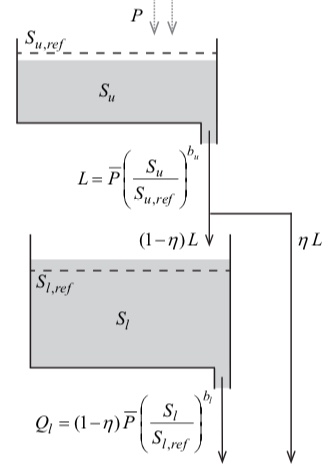
Kirchner 2016 model

I open a new series of posts that analyze simple (or less simple) lumped (reservoir based) Hydrological Models. They are Dynamical Systems and they are well represented through Petri Nets introduced in Reservoirology #3. The present is the case of a simple two reservoirs model presented in Kirchner 2016 (from now on, K2016b).


Because of  its simplicity, K2016b is a nice case study to test and verify various aspect treated more abstractly in Rigon et al., 2016.  The presentation that contains K2016 is here.

Reference

Kirchner, J. W. (2016). Aggregation in environmental systems-Part 2. Catchment mean transit times and young water fractions under hydrologic non-stationarity. Hess, 20, 299–328. http://doi.org/10.5194/hess-20-299-2016

Thursday, August 2, 2018

Categories of systems of equations in ODEs based hydrological systems

This is the continuation of the reservoirology topic saga.  Especially preparatory for understanding  is the Reservoirology #3 post. Here we show that the same topological structure of Petri Nets can address various physical concepts related to a hydrological system conceptualised as a set of reservoir and therefore solvable as a set of ODEs.
The main ODE system, however, does not reveal all of the system. A finer inspection can be obtained by investigating travel times and concentration of tracers (being the theoretical point of view, the first, the experimental one, the second).

To fix some concept we wrote the short presentations above. Or just click here. The pdf contains itself links to other posts and literature.

Monday, January 16, 2017

Reservoirology #4: the case of Richards 1d

This is the follow up of Reservoirology #3 post, where (there) I used  Petri nets to represent ordinary differential equations (ODEs). Here, instead, I try to use the same graphical formalism to represent Partial Differential Equations (PDEs), by extending a little the graphics.
Let's say that the number of specifications needed is larger here and, therefore, a lot of ancillary information has to be conveyed through Tables (and some interpretation). However, click on the figure above if you are curious to know more.

Monday, November 7, 2016

Reservoirology #3

This is a revision of the previous post on the same topic. There I tried to develop my own algebra of symbols to represent coarse grained (spatially integrated) hydrological system. Later on I understood that Petri networks were already there and useful to obtain the same result. The graphs obtained in such a way where, besides, studied in several places, and many contributes of literature convergent from other disciplines, can be used for hydrological scopes.
The presentation (click on the figure) completely substitutes the old one. Who liked it, will like better this.  When you will be done with this post, consider that there is also Reservoirology #4.

THIS MATERIAL IS NOW REFINED AND PUBLISHED IN WATER RESOURCES RESEARCH. YOU CAN FIND THE PAPER HERE.